| “엔진에서 AI로”… 민형배, 광주 자동차산업 ‘AI 미래모빌리티 대전환’ 선언 미래차 기업 100개·AI 자율제조 200개 육성… 10만 일자리 창출 비전 ai호남뉴스 박충배 편집/칼럼/논설 aihnnewsr@kakao.com |
| 2026년 03월 16일(월) 11:08 |
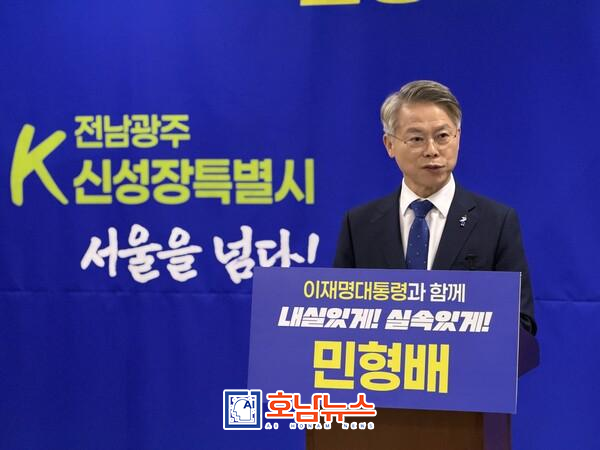 민형배의원 프로필 / 사진제공=민형배의원실 |
더불어민주당 전남·광주 통합특별시장 경선 후보인 민형배 국회의원(광주 광산구을)이 광주 자동차산업을 기존 내연기관 중심 구조에서 ‘AI 미래모빌리티 산업’으로 대전환하겠다는 비전을 공식 발표했다.
민 의원은 15일 정책 발표를 통해 “자동차 산업은 전기차·자율주행·차량용 반도체·소프트웨어 중심 자동차(SDV)·AI 자율제조가 결합된 첨단산업으로 빠르게 재편되고 있다”며 “광주의 자동차산업 역시 내연기관 중심 생산구조에서 AI 기반 미래모빌리티 산업으로 전환해야 한다.”고 강조했다.
그는 광주가 기아 광주공장과 광주글로벌모터스를 보유한 국내 대표 자동차 생산도시인 동시에 AI 집적단지와 국가 데이터센터, 자율주행 실증 인프라 등 미래산업 기반을 갖춘 도시라는 점을 강조하며 “AI 미래모빌리티 생산도시 광주”라는 산업 비전을 제시했다.
■ “2030년 미래차 기업 100개·AI 자율제조 200개 육성”
민 의원은 광주 자동차 산업 구조 전환을 위해 2030년까지 다음과 같은 목표를 제시했다.
미래차 전환기업 100개 이상 육성, AI 자율제조 전환기업 200개 이상 육성, 미래모빌리티 신사업 200개 창출, 양질의 일자리 10만 개 창출.
그는 “자동차산업 대전환은 단순한 산업 정책이 아니라 지역경제 구조를 바꾸는 미래 전략”이라며 광주 자동차 산업의 체질을 AI 기반 첨단산업으로 바꾸겠다는 구상을 밝혔다.
■ “광주 완성차 공장, AI·로봇 기반 미래차 생산플랫폼으로”
민 의원은 이를 위해 광주의 완성차 생산기지를 피지컬 AI와 로봇, 디지털 트윈 기반의 미래차 생산 플랫폼으로 전환하겠다고 밝혔다.
특히 지역 자동차 부품기업을 다음과 같은 고부가가치 미래차 산업으로 전환한다는 계획이다.
전장부품, 차량용 반도체 관련 부품, 자율주행 센서, 배터리 구조체, 스마트 의장, 차량 소프트웨어 연계 부품, 이를 통해 기존 부품기업을 미래차 산업 생태계 핵심 기업으로 성장시키겠다는 전략이다.
■ 자율주행 실증도시·모빌리티 데이터 허브 구축
민 의원은 광주를 미래모빌리티 산업 핵심 거점으로 육성하기 위해 다음과 같은 전략도 제시했다.
AI 자율제조 혁신 추진, 자율주행 실증도시 조성, 모빌리티 데이터 허브 구축, 이를 통해 광주를 미래차 기술 개발과 실증, 생산이 동시에 이루어지는 산업 도시로 성장시키겠다는 구상이다.
■ “광주 완성차 + 전남 에너지”… 미래모빌리티 산업벨트
민 의원은 이 구상을 광주와 전남을 연결한 ‘미래모빌리티 산업벨트’ 구축으로 완성하겠다고 밝혔다.
구상에 따르면 광주 → 완성차 생산·AI·자율주행 실증 중심지, 전남 → 에너지·소재·배터리 산업 기반을 맡아 완성차·AI·에너지·소재가 결합된 광역 미래모빌리티 산업 생태계를 구축하게 된다.
이는 전남·광주 통합특별시 출범 이후 초 광역 산업 전략의 핵심 축이 될 것이라는 설명이다.
■ “산업 전환 속 일자리도 지역에서 만든다.”
민 의원은 산업 전환 과정에서 재직자 전환교육과 청년 인재 양성도 함께 추진하겠다고 밝혔다.
특히 재직자 미래차 산업 전환 교육, 청년 AI·모빌리티 전문 인재 양성
실증사업과 기업 채용 연계, 등을 통해 미래차 산업 일자리 10만 개를 지역에서 창출하겠다는 계획이다.
민형배 의원은 “광주 자동차산업 대전환은 낡은 산업을 방어하는 정책이 아니라 지역 기업을 미래차 산업의 주역으로 키우는 전략”이라며
“광주와 전남의 강점을 결합해 대한민국 미래모빌리티 산업도시를 만들고 광주 자동차산업의 새로운 성장 시대를 열겠다.”고 말했다.
“From Engines to AI”… Min Hyung-bae Declares Major Shift of Gwangju’s Auto Industry to AI-Driven Future Mobility
Plan to Foster 100 Future-Car Companies and 200 AI Autonomous Manufacturing Firms… Create 100,000 Jobs
Build a ‘Future Mobility Industrial Belt’ Linking Gwangju’s Automakers and AI with Jeonnam’s Energy Industry
[Jeonnam·Gwangju = AI Honam News] aihnnews@kakao.com
Rep. Min Hyung-bae (Gwangju Gwangsan-eul), a candidate in the Democratic Party primary for mayor of the proposed Jeonnam-Gwangju Special Metropolitan City, has unveiled a vision to transform Gwangju’s automobile industry from a traditional internal-combustion-engine structure into an AI-driven future mobility industry.
In a policy announcement released on the 15th, Rep. Min said that the global automotive industry is rapidly evolving into a high-tech sector combining electric vehicles, autonomous driving, automotive semiconductors, software-defined vehicles (SDVs), and AI-based autonomous manufacturing.
“Gwangju’s automobile industry must also transition from an internal-combustion-engine production structure to an AI-based future mobility industry,” he emphasized.
Min noted that Gwangju is one of Korea’s leading automobile production cities, home to Kia’s Gwangju plant and Gwangju Global Motors, while also possessing advanced infrastructure such as an AI convergence cluster, a national data center, and autonomous driving testbeds.
Based on these strengths, he presented the vision of “Gwangju as an AI Future Mobility Production City.”
■ “100 Future-Car Firms and 200 AI Autonomous Manufacturing Companies by 2030”
To transform the industrial structure of Gwangju’s automobile sector, Min presented the following targets by 2030:
Foster more than 100 companies transitioning to future vehicles
Develop over 200 companies adopting AI autonomous manufacturing
Create 200 new future mobility businesses
Generate 100,000 quality jobs
He stressed that the transition of the automotive industry is not merely an industrial policy but a strategic shift that will reshape the regional economic structure, aiming to transform Gwangju’s automotive sector into an AI-based advanced industry.
■ “Transform Gwangju’s Car Plants into AI- and Robotics-Based Production Platforms”
Min also proposed transforming Gwangju’s automobile manufacturing base into a future vehicle production platform based on physical AI, robotics, and digital twin technologies.
Local automotive parts companies would be upgraded to high-value sectors such as:
Electronic vehicle components
Automotive semiconductor-related parts
Autonomous driving sensors
Battery structural components
Smart interior systems
Software-linked vehicle components
The goal is to help existing parts manufacturers become key players in the future mobility ecosystem.
■ Building an Autonomous Driving Test City and Mobility Data Hub
To position Gwangju as a core hub for the future mobility industry, Min proposed several strategic initiatives:
Innovation in AI autonomous manufacturing
Development of an autonomous driving test city
Establishment of a mobility data hub
These measures aim to turn Gwangju into an industrial city where future mobility technologies are developed, tested, and manufactured simultaneously.
■ “Gwangju Automakers + Jeonnam Energy”… A Future Mobility Industrial Belt
Min said the vision would be completed by building a “Future Mobility Industrial Belt” linking Gwangju and Jeonnam.
Under the plan:
Gwangju would serve as the center for automobile production, AI development, and autonomous driving testing
Jeonnam would provide the base for energy, materials, and battery industries
Together, they would create a regional ecosystem combining automobiles, AI, energy, and advanced materials.
Min explained that this initiative would become a core ultra-regional industrial strategy after the launch of the Jeonnam-Gwangju Special Metropolitan City.
■ “Create Future Mobility Jobs Locally”
Min also emphasized that the industrial transition would be accompanied by workforce transformation and talent development.
Key initiatives include:
Reskilling programs for workers transitioning to the future mobility sector
Training programs for young AI and mobility specialists
Linking demonstration projects with corporate hiring opportunities
Through these measures, he aims to create 100,000 future mobility jobs within the region.
Rep. Min Hyung-bae stated:
“The transformation of Gwangju’s automobile industry is not about defending an outdated industry.
It is a strategy to nurture regional companies as leading players in the future mobility era.
By combining the strengths of Gwangju and Jeonnam, we will build a global future mobility industrial city and open a new growth era for Gwangju’s automotive industry.”
 ai호남뉴스 박충배 편집/칼럼/논설 aihnnewsr@kakao.com