| “광주를 다시 짓밟기 위한 총구”… 1980년 5월 24일, 계엄군 오인교전과 송암동 학살의 하루
광주 재진입작전 준비 속 계엄군끼리 총격전… 민간인·학생 희생 이어져 ai호남뉴스 박충배 편집/칼럼/논설 aihnnewsr@kakao.com |
| 2026년 05월 18일(월) 12:55 |
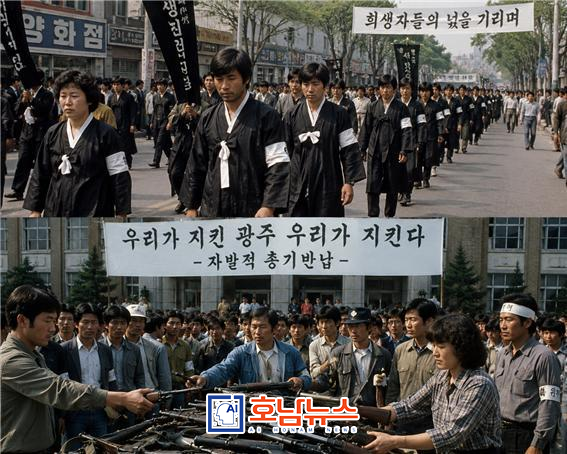 5.18 광주 민주화 항쟁 / 사진제공=chat gpt |
【전남·광주=AI호남뉴스】 aihnnews@kakao.com
1980년 5월 24일의 광주는 겉으로는 잠시 숨을 고르는 듯했지만, 도시 외곽에서는 다시 광주를 장악하기 위한 계엄군의 재진입 작전이 본격화되고 있었다.
그날 광주는 시민들의 자치와 연대가 이어지고 있었지만, 군은 이미 ‘최후 진압’을 준비하며 도시를 포위하고 있었다.
새벽 1시 30분.
계엄군은 광주 재진입작전을 준비하기 위해 외곽에 배치됐던 공수부대를 20사단 병력으로 교체하기 시작했다.
이는 단순한 병력 이동이 아니었다.
광주를 다시 군사력으로 점령하기 위한 최종 진압작전의 사전 정비였다.
그러나 긴장과 혼란 속에서 계엄군 내부의 오인 교전이 잇따라 발생했다.
오전 9시 50분께 광주톨게이트 인근에서는 31사단 96연대 병력과 전교사 기갑학교 병력 간 오인 사격이 벌어졌다.
아군을 시민군으로 착각한 계엄군은 서로를 향해 총격을 가했고, 이 과정에서 31사단 병력 3명이 사망하고 9명이 부상을 입었다.
현장 인근에서는 어린이와 민간인들도 총탄과 파편에 다쳐 큰 혼란이 벌어졌다.
하지만 비극은 여기서 끝나지 않았다.
오후 1시 20분께 송암동 일대를 지나던 11공수여단 병력은 도로 양측을 향해 무차별 총격을 가했다.
당시 현장에는 무장 시민군뿐 아니라 평범한 주민들과 학생들도 있었다.
이 총격으로 중학생과 국민학생이 숨졌고, 다수의 민간인이 피해를 입었다.
광주 시민들에게 총구를 겨눈 국가폭력은 이제 어린 학생들까지 가리지 않았다.
이어 오후 1시 55분.
송암동 효천역 부근에서는 또다시 대규모 오인 교전이 발생했다.
11공수여단 병력과 전교사 기갑학교 교도대 병력이 서로를 시민군으로 오인해 집중 사격을 벌인 것이다.
이 교전으로 계엄군 9명이 사망하고 38명이 부상당했다.
극도의 공포와 과잉 진압 속에서 계엄군은 자신들조차 식별하지 못할 만큼 혼란 상태에 빠져 있었다.
문제는 그 이후였다.
오후 2시께 오인 교전 직후 흥분한 공수부대는 인근 주택가를 수색하며 시민들을 무차별 연행하기 시작했다.
이 과정에서 청년 3명이 현장에서 사살됐다.
정식 조사도, 체포 절차도 없었다.
광주의 시민들은 단지 그 자리에 있었다는 이유만으로 총탄 앞에 쓰러졌다.
반면 도심의 전남도청 앞 광장에서는 시민들의 저항 의지가 꺾이지 않고 있었다.
오후 3시, 시민 3만5천여 명이 모인 가운데 제2차 시민궐기대회가 열렸다.
시민들은 계엄군의 만행을 규탄하며 민주주의 수호 의지를 다시 확인했다.
광장에서는 당시 신군부 핵심이었던 전두환에 대한 화형식도 진행됐다.
시민들은 외쳤다.
광주는 굴복하지 않겠다고.
총칼로 민주주의를 짓밟을 수는 없다고.
그러나 도시 외곽에서는 이미 계엄군의 최종 진압작전이 완성 단계로 접어들고 있었다.
5월 24일은 단순한 ‘오인 교전의 날’이 아니었다.
그것은 국가폭력이 광주 재진입을 준비하며 시민과 군인 모두를 죽음으로 몰아넣은 비극의 하루였다.
특히 송암동 오인 교전과 민간인 학살은 당시 계엄군 작전 체계가 얼마나 무분별하고 통제 불능 상태였는지를 보여주는 대표적 사례로 남아 있다.
국민을 보호해야 할 군대가 시민에게 총을 겨누고, 심지어 서로에게까지 총탄을 퍼부었던 그날의 광주는 대한민국 현대사의 가장 비극적인 국가폭력 현장 중 하나였다.
[AI Honam News Special]
“Guns Turned Again to Crush Gwangju”… May 24, 1980, the Day of Friendly Fire and the Songam-dong Massacre
Friendly-fire clashes among martial law troops during preparations to re-enter Gwangju… civilians and students among the victims
【Gwangju & Jeonnam = AI Honam News】 aihnnews@kakao.com
On May 24, 1980, Gwangju appeared, on the surface, to be catching its breath for a brief moment.
But outside the city, martial law forces were already accelerating preparations for a full-scale re-entry operation to retake Gwangju by force.
While citizens inside the city continued to maintain order and solidarity on their own, the military had already surrounded Gwangju and was preparing what it considered a “final suppression operation.”
At 1:30 a.m., martial law authorities began replacing airborne special forces stationed around the outskirts with units from the 20th Infantry Division in preparation for the re-entry operation.
This was not a simple troop rotation.
It was a calculated military maneuver designed to pave the way for the violent recapture of Gwangju.
However, amid extreme tension and confusion, a series of friendly-fire incidents erupted among the martial law forces themselves.
At approximately 9:50 a.m., near the Gwangju Tollgate, troops from the 96th Regiment of the 31st Division exchanged fire with armored training units from the Army Combat School.
Mistaking one another for armed civilian militias, the soldiers opened fire.
As a result, three soldiers from the 31st Division were killed and nine others were wounded.
Children and civilians near the scene were also injured by bullets and shrapnel, throwing the area into chaos.
But the tragedy did not end there.
At around 1:20 p.m., troops from the 11th Airborne Brigade passing through Songam-dong opened indiscriminate fire toward both sides of the road.
At the scene were not only armed citizens but also ordinary residents and students.
A middle school student and an elementary school student were killed in the gunfire, while numerous civilians were injured.
State violence directed at the citizens of Gwangju no longer spared even children.
Then, at approximately 1:55 p.m., another large-scale friendly-fire clash broke out near Hyocheon Station in Songam-dong.
Troops from the 11th Airborne Brigade and cadet units from the Army Combat School again mistook each other for citizen militias and engaged in intense gunfire.
Nine martial law soldiers were killed and 38 wounded in the exchange.
Consumed by fear and driven by excessive military aggression, the troops had descended into such confusion that they could no longer distinguish even their own forces.
What followed was even more horrifying.
At around 2:00 p.m., immediately after the friendly-fire clash, enraged airborne troops began searching nearby residential neighborhoods and arbitrarily detaining civilians.
During the operation, three young men were summarily executed on the spot.
There was no investigation, no arrest procedure, and no due process.
The citizens of Gwangju were killed simply for being there.
Meanwhile, in downtown Gwangju, the spirit of resistance remained unbroken.
At 3:00 p.m., approximately 35,000 citizens gathered in front of the former Jeonnam Provincial Office for the Second Citizens’ Rally.
The crowd condemned the atrocities committed by the martial law forces and reaffirmed their determination to defend democracy.
A public burning ceremony targeting then–new military strongman Chun Doo-hwan was also held at the square.
The citizens shouted:
Gwangju would not surrender.
Democracy could not be crushed by guns and bayonets.
Yet outside the city, the military’s final suppression operation was already nearing completion.
May 24 was not merely “the day of friendly fire.”
It was a day when state violence, in preparation for the military reoccupation of Gwangju, drove both civilians and soldiers alike toward death.
The Songam-dong friendly-fire incident and civilian killings remain among the clearest examples of how reckless, chaotic, and uncontrollable the martial law operation had become.
On that day, the military — which was meant to protect the people — turned its weapons against civilians, and even against itself.
The Gwangju of May 24, 1980, remains one of the most tragic scenes of state violence in modern Korean history.
 ai호남뉴스 박충배 편집/칼럼/논설 aihnnewsr@kakao.com