| “광주는 끝까지 인간이었다”… 1980년 5월 26일, 탱크 앞에 맨몸으로 선 시민들의 ‘죽음의 행진’
수습위원·시민군 마지막 결단… 윤상원 “광주의 진실을 세계에 알려달라” 외신 호소 ai호남뉴스 박충배 편집/칼럼/논설 aihnnewsr@kakao.com |
| 2026년 05월 18일(월) 13:34 |
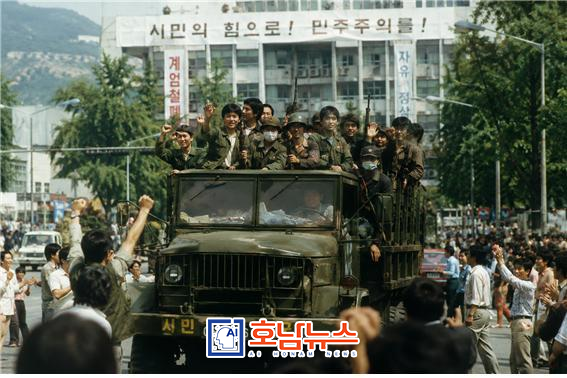 5.18 광주민주화운동 순찰 / 사진제공=chat gpt |
【전남·광주=AI호남뉴스】 aihnnews@kakao.com
1980년 5월 26일의 광주는 마지막 밤을 준비하고 있었다.
도시는 이미 포위돼 있었다.
광주 외곽에는 3·7·11공수여단 계엄군이 집결했고, 군은 시민들을 향한 최후 진압작전을 본격화하고 있었다.
그러나 광주는 끝까지 무너지지 않았다.
그날 시민들은 총보다 인간의 양심을 믿었다.
탱크 앞에 맨몸으로 섰고, 죽음을 알면서도 거리로 나왔다.
5월 26일은 단순한 ‘진압 전야’가 아니었다.
대한민국 민주주의 역사에서 가장 처절했던 마지막 시민 저항의 날이었다.
새벽 4시.
광주 외곽에 배치돼 있던 계엄군은 장갑차를 앞세우고 시내 방향으로 전진 배치됐다.
이미 광주공항에는 대규모 병력이 집결해 있었다.
계엄군은 시민군 최종 진압을 위한 본격적인 학살 작전에 돌입했고, 3공수·7공수·11공수 대원들에게는 실탄 140발씩이 지급됐다.
광주는 사실상 전쟁 직전의 도시가 되어가고 있었다.
오전 8시.
김성용 신부를 비롯한 수습대책위원회 관계자 17명은 마지막 결단을 내렸다.
계엄군 탱크와 장갑차를 막기 위해 시민들과 함께 맨몸 행진에 나선 것이다.
이른바 ‘죽음의 행진’이었다.
시민들은 도청에서 계엄군 진입 방향까지 약 4km 구간을 걸으며 “더 이상의 학살은 안 된다”, “광주 시민을 살려달라”고 외쳤다.
누군가는 울었고, 누군가는 주먹을 움켜쥐었다.
그러나 누구도 뒤로 물러서지 않았다.
총칼 앞에서 맨몸으로 탱크를 막아선 시민들의 모습은 광주가 왜 민주주의의 성지가 되었는지를 보여주는 상징이었다.
오전 11시.
금남로 일대에서는 시민 3만여 명이 참여한 제4차 민주수호 범시민 궐기대회가 열렸다.
시민들은 “광주를 지켜야 한다.”, “끝까지 항쟁하자”고 외쳤지만, 동시에 더 이상의 희생을 막아야 한다는 절박함도 함께 안고 있었다.
정오 무렵에는 항쟁지도부와 시민군 내부에서 ‘기동타격대’가 편성됐다.
계엄군 재진입 시 도청과 주요 거점을 방어하기 위한 최후의 조직이었다.
이미 시민군은 군사력으로 계엄군을 막기 어렵다는 사실을 알고 있었다.
그럼에도 누군가는 끝까지 남아야 했다.
광주의 진실이 완전히 짓밟히지 않도록 하기 위해서였다.
오후 1시.
안병하 전남도경국장이 광주공항에서 치안본부로 연행됐다.
안 국장은 시민들에게 경찰 발포를 거부하고 과잉 진압을 막으려 했던 인물이었다.
그의 연행은 국가권력이 ‘시민 보호’보다 ‘무력 진압’을 선택했다는 상징적 사건이었다.
오후 3시.
시민 2만여 명이 다시 제5차 민주수호 범시민 궐기대회를 열었다.
광장은 분노와 슬픔, 결의와 공포가 뒤섞인 거대한 인간의 바다가 됐다.
그리고 오후 5시.
시민군 대변인 윤상원은 외신 기자회견을 열어 광주의 참상을 세계에 알렸다.
윤상원은 기자들 앞에서 계엄군의 학살과 광주의 고립 상황을 증언하며 국제사회가 광주의 현실을 외면하지 말아 달라고 호소했다.
그는 마지막까지 광주 시민들의 목소리를 세상 밖으로 전하려 했다.
“우리는 폭도가 아니다.
우리는 민주주의를 지키려는 시민이다.”
윤상원의 외침은 훗날 광주를 넘어 대한민국 민주주의의 양심으로 남게 된다.
밤이 깊어가던 자정 무렵.
계엄사령부는 시민군에게 최후 통첩을 보냈다.
동시에 시내전화가 끊겼다.
광주는 완전히 고립됐다.
도시는 마지막 순간을 향해 가고 있었다.
그러나 시민들은 끝까지 서로를 지켰다.
누군가는 도청에 남았고, 누군가는 주먹밥을 만들었으며, 누군가는 마지막 방송을 준비했다.
1980년 5월 26일의 광주는 패배를 앞둔 도시가 아니었다.
그날 광주는 끝까지 인간의 존엄과 민주주의를 포기하지 않았던 도시였다.
탱크 앞에 맨몸으로 섰던 시민들의 행진은 단순한 저항이 아니라, 국가폭력 앞에서도 인간다움을 잃지 않으려 했던 대한민국 민주주의 최후의 양심이었다.
그리고 그날의 죽음의 행진은 지금도 우리에게 묻고 있다.
국가는 누구를 위해 존재해야 하는가.
민주주의는 누가 지켜내는가.
그리고 우리는 그날 광주의 희생 앞에 얼마나 정직한가.
【AI Honam News Column】
“Gwangju Remained Human Until the Very End” — May 26, 1980, the ‘March of Death’ of Citizens Standing Barehanded Before Tanks
Final resolve of the mediation committee and citizen militia… Yoon Sang-won appeals to foreign journalists: “Tell the world the truth about Gwangju”
【Gwangju·Jeonnam = AI Honam News】 aihnnews@kakao.com
On May 26, 1980, Gwangju was preparing for its final night.
The city was already surrounded.
Outside Gwangju, martial law troops from the 3rd, 7th, and 11th Airborne Brigades had assembled, and the military was preparing its final operation to suppress the citizens.
Yet Gwangju did not collapse until the very end.
That day, the citizens believed in human conscience more than guns.
They stood barehanded before tanks and marched into the streets knowing death awaited them.
May 26 was not merely the eve of a military crackdown.
It was one of the most desperate final acts of civilian resistance in the history of Korean democracy.
At 4 a.m., martial law troops stationed around Gwangju advanced toward the city center with armored vehicles at the front.
A massive military force had already gathered at Gwangju Airport.
The military had begun preparations for a full-scale massacre aimed at crushing the citizen militia, and soldiers of the 3rd, 7th, and 11th Airborne Brigades were reportedly issued 140 rounds of live ammunition each.
Gwangju was becoming a city on the brink of war.
At 8 a.m., Father Kim Seong-yong and 17 members of the mediation committee made a final decision.
Together with citizens, they launched a barehanded march to stop the tanks and armored vehicles of the martial law forces.
It became known as the “March of Death.”
Citizens walked nearly four kilometers from the Provincial Government Office toward the direction of the advancing troops, shouting, “Stop the massacre,” and “Save the citizens of Gwangju.”
Some wept.
Others clenched their fists.
But no one stepped back.
The sight of unarmed citizens standing before tanks and rifles became a lasting symbol of why Gwangju would later be remembered as the sacred ground of Korean democracy.
At 11 a.m., around 30,000 citizens gathered along Geumnam-ro for the Fourth Pan-Citizen Rally to Defend Democracy.
The crowd shouted, “We must protect Gwangju,” and “Fight to the end,” while at the same time carrying the desperate hope of preventing further bloodshed.
Around noon, the resistance leadership and citizen militia organized a “Mobile Strike Unit,” a final defense force intended to protect the Provincial Government Office and key locations if the military re-entered the city.
The citizen militia already understood that they could not defeat the military through force alone.
Even so, someone had to remain until the end — so that the truth of Gwangju would not be completely crushed and erased.
At 1 p.m., Ahn Byeong-ha, Commissioner of the Jeonnam Provincial Police, was taken from Gwangju Airport to National Police Headquarters.
Ahn had refused to order police gunfire against civilians and had attempted to prevent excessive violence against citizens.
His arrest symbolized the moment when state power chose military suppression over the protection of its people.
At 3 p.m., another 20,000 citizens gathered for the Fifth Pan-Citizen Rally to Defend Democracy.
The square became a vast sea of grief, anger, determination, and fear.
Then, at 5 p.m., citizen militia spokesperson Yoon Sang-won held a press conference for foreign journalists to reveal the truth about Gwangju to the world.
Before reporters, Yoon testified about the massacres carried out by martial law forces and the complete isolation of the city, pleading with the international community not to ignore what was happening in Gwangju.
Until the very end, he tried to carry the voices of Gwangju’s citizens beyond the barricaded city.
“We are not rioters.
We are citizens trying to defend democracy.”
Yoon Sang-won’s words would later remain not only as the voice of Gwangju, but as the conscience of Korean democracy itself.
Near midnight, martial law authorities issued a final ultimatum to the citizen militia.
At the same time, telephone lines throughout the city were cut.
Gwangju was completely isolated.
The city was moving toward its final hours.
Yet the citizens continued to protect one another until the very end.
Some remained inside the Provincial Government building.
Some prepared rice balls for the fighters and civilians.
Others made final broadcasts to the city.
The Gwangju of May 26, 1980, was not a city awaiting defeat.
It was a city that refused to surrender human dignity and democracy until the very end.
The march of citizens standing barehanded before tanks was not merely an act of resistance.
It was the final conscience of Korean democracy — a determination to remain human even in the face of brutal state violence.
And even today, that March of Death continues to ask us:
For whom should a state exist?
Who truly protects democracy?
And how honest are we before the sacrifices made in Gwangju?
 ai호남뉴스 박충배 편집/칼럼/논설 aihnnewsr@kakao.com