2026.03.26 (목) 18:51


 닫기
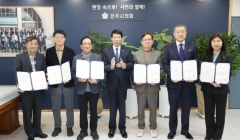
닫기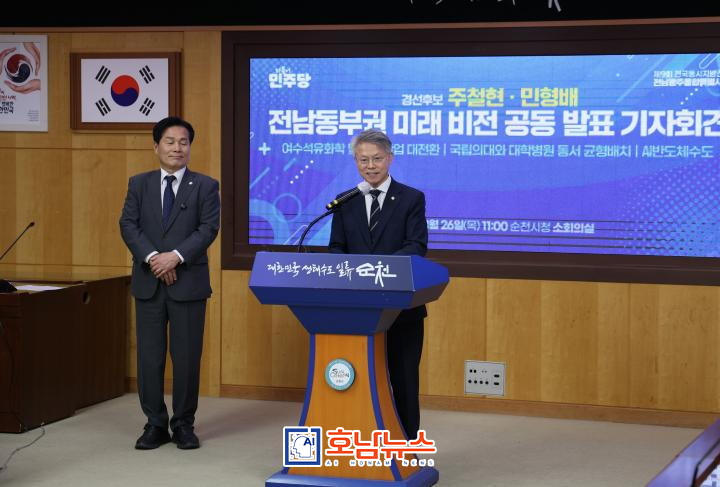 민형배 주철현 공동 기자회견 / 사진제공=민형배의원실 |
전남·광주 통합특별시장 경선이 ‘정책 연대’라는 새로운 변수와 함께 중대한 분기점을 맞았다.
더불어민주당 경선에 나선 민형배 국회의원(광주 광산구을)과 주철현 국회의원(전남 여수갑)은 26일 전남 순천시청에서 공동 기자회견을 열고, 전남 동부권 미래 전략을 중심으로 한 정책 연대를 공식 선언했다.
이번 연대는 경선 국면에서 후보 간 이해관계를 넘어 ‘정책 중심 협력’이 처음으로 현실화됐다는 점에서 정치권 안팎의 주목을 받고 있다. 특히 통합 논의 과정에서 상대적 소외 우려가 제기돼 온 전남 동부권을 핵심 축으로 설정했다는 점에서, 단순한 선언을 넘어 구조적 균형 재편의 신호탄으로 평가된다.
■ “동부권이 빠지면 통합은 없다”… 산업·의료·반도체 3대 축 공동 설계
두 후보는 공동 기자회견문을 통해 전남 동부권의 구조적 도약을 위한 3대 공동 과제를 제시했다.
핵심은 산업·에너지 전환, 공공의료 체계 재설계, 반도체 산업 생태계 구축이다.
먼저 산업 분야에서는 여수 석유화학과 광양 철강 중심의 기존 산업 구조를 친환경·고부가가치 산업으로 전면 전환하겠다는 구상이 담겼다.
석유화학단지는 이차전지 소재, 바이오화학, 친환경 플라스틱 중심으로 재편하고, 고온가스로 기반 소형모듈원전(SMR) 실증사업을 통해 무탄소 에너지 공급 체계를 구축한다는 전략이다.
이는 단순한 산업 보완이 아니라, ‘탄소 중심 산업 → 미래 에너지 산업’으로의 체질 전환을 의미한다.
■ “의료 격차가 곧 생존 격차”… 전남형 공공의료 모델 제시
의료 분야에서는 전남의 구조적 취약점으로 지적돼 온 ‘의료 공백’ 해소를 위한 통합형 모델이 제시됐다.
두 후보는
△목포대·순천대 의대 정원 각각 50명 배정
△동부·서부 권역별 대학병원 균형 배치
△지역 거점병원 중심 수련체계 구축을 골자로 한 ‘전남형 공공의료 모델’을 제안했다.
이는 단순한 병원 확충이 아닌, 의료 인력 양성–배치–정착까지 이어지는 ‘완결형 지역 의료 시스템’을 구축하겠다는 구상이다.
■ “수도권 독점 깨겠다”… 반도체 트라이앵글로 산업지도 재편
반도체 분야에서는 ‘광주–서부–동부’로 이어지는 삼각 축 산업 구조를 제시했다.
광주는 설계·패키징, 서부권은 생산, 동부권은 소재·부품·장비 연구개발을 맡는 역할 분담을 통해 전남·광주 전체를 하나의 ‘완결형 반도체 생태계’로 구축하겠다는 전략이다.
특히 재생에너지와 풍부한 산업 용수 기반을 결합해, 수도권에 집중된 반도체 투자 흐름을 지역으로 전환하겠다는 의지가 담겼다.
■ “정치 아닌 구조를 바꾼다”… 민형배·주철현, 통합의 방식 제시
민형배 후보는 “동·서부권 간 인식 격차를 해소하기 위해 먼저 정책 연대를 제안했다”며 “최종 후보가 누구로 결정되더라도 오늘 합의한 정책은 공동 공약으로 이어갈 것”이라고 밝혔다.
주철현 후보 역시 “동부권 핵심 현안에 대해 뜻을 함께했다는 점에서 의미가 크다”며 “시민의 삶을 바꾸는 정책이 통합시장 공약으로 이어지길 기대한다.”고 강조했다.
양측은 이번 연대가 후보 단일화와는 무관하다는 점도 분명히 했다.
주 후보는 “민주적 경선 원칙에 따라 각자의 비전과 정책을 충분히 설명하고, 선택된 후보를 지지하는 것이 원칙”이라고 선을 그었다.
■ “주민을 위한 민주 연대”… 정치 연합이 아닌 정책 연합
민형배 후보는 이번 연대를 “주민(주·민)을 위한 민주(민·주) 연대”라고 규정했다.
이는 정치적 이해관계가 아닌, 지역 주민의 삶을 기준으로 한 정책 연대라는 점을 분명히 한 표현이다.
이번 선언은 단순한 협력 이상의 의미를 갖는다.
경선 구도를 ‘대결’에서 ‘정책 경쟁+전략 공조’로 확장시키는 동시에,
통합특별시 논의의 중심을 ‘균형’과 ‘실행력’으로 이동시키는 계기가 될 가능성이 크다.
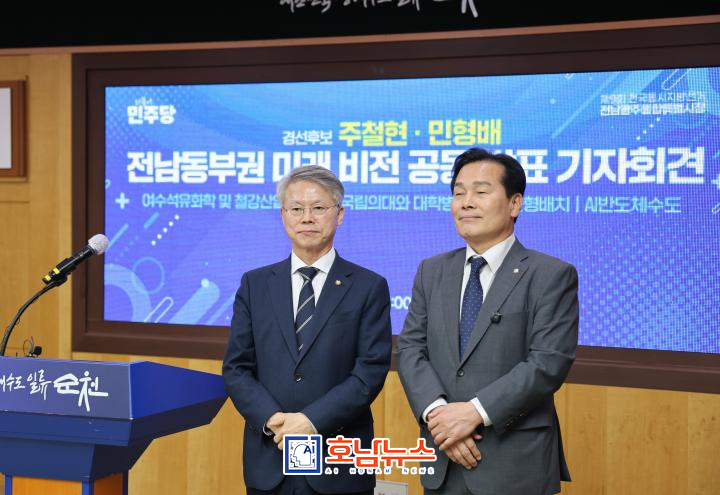 민형배 주철현 공동 기자회견 / 사진제공=민형배의원실 |
“The Eastern Region Will Reshape the Game”… Min Hyung-bae and Joo Cheol-hyun Declare First Policy Alliance
Joint Design of ‘Three Major Transformations’ in Industry, Healthcare, and Semiconductors Signals Rebalancing of the Integrated Special City
“A Democratic Alliance for the People”… Strategic Cooperation to Bridge East–West Divide Gains Momentum
“Not a Unification Move, but an Expansion of Policy Competition”… A New ‘Cooperation Variable’ Enters the Primary Race
【Jeonnam·Gwangju = AI Honam News】 aihnnews@kakao.com
The primary race for the Jeonnam–Gwangju Integrated Special City has reached a critical turning point with the emergence of a new variable: a policy alliance.
Min Hyung-bae, a National Assembly member representing Gwangju (Gwangsan-eul), and Joo Cheol-hyun, a National Assembly member representing Yeosu (Jeonnam), both candidates in the Democratic Party primary, officially declared a policy alliance on March 26 during a joint press conference held at Suncheon City Hall.
This alliance is drawing significant attention as it marks the first instance of “policy-centered cooperation” among candidates, going beyond political competition. In particular, it is being seen as a signal of structural rebalancing, as it places the often-overlooked eastern region of Jeonnam at the core of the integrated city’s future vision.
■ “There Is No Integration Without the Eastern Region”… Joint Blueprint for Three Key Axes
In their joint statement, the two candidates presented three major policy agendas aimed at driving structural transformation in eastern Jeonnam:
Industrial and energy transition
Public healthcare system redesign
Semiconductor industry ecosystem development
In the industrial sector, they proposed a full-scale transition of Yeosu’s petrochemical complex and Gwangyang’s steel industry toward eco-friendly and high-value-added industries.
The petrochemical complex would be restructured to focus on secondary battery materials, biochemicals, and eco-friendly plastics. Additionally, they plan to establish a carbon-free energy supply system through the demonstration of high-temperature gas reactor-based Small Modular Reactors (SMRs).
This represents not merely industrial enhancement, but a fundamental shift from a carbon-based industrial model to a future-oriented energy industry.
■ “Healthcare Inequality Is Survival Inequality”… Proposal for a Jeonnam-Style Public Healthcare Model
In the healthcare sector, the candidates addressed Jeonnam’s long-standing structural vulnerability—medical service gaps—by proposing an integrated model.
Key proposals include:
Allocation of 50 medical school seats each to Mokpo National University and Sunchon National University
Balanced placement of university hospitals in eastern and western regions
Establishment of a training system centered on regional hub hospitals
This model goes beyond expanding hospital infrastructure, aiming instead to create a complete regional healthcare system encompassing workforce training, deployment, and long-term retention.
■ “We Will Break the Capital Region Monopoly”… Semiconductor Triangle Strategy
For the semiconductor sector, the candidates proposed a triangular industrial structure linking Gwangju, western Jeonnam, and eastern Jeonnam.
Gwangju: Design and packaging
Western region: Manufacturing
Eastern region: Materials, parts, and equipment R&D
Through this division of roles, they aim to establish a fully integrated semiconductor ecosystem across the region.
Leveraging renewable energy resources and abundant industrial water, the strategy seeks to attract large-scale investments and decentralize the industry away from its current concentration in the Seoul metropolitan area.
■ “We Are Changing Structures, Not Playing Politics”… A New Model of Integration
Min Hyung-bae stated, “To bridge the perception gap between eastern and western regions, I first proposed this policy alliance,” adding, “Regardless of who becomes the final candidate, the agreed policies will be carried forward as joint pledges.”
Joo Cheol-hyun also emphasized, “It is meaningful that we have aligned on key issues concerning the eastern region,” and expressed hope that “policies that truly improve citizens’ lives will be reflected in the final mayoral platform.”
Both candidates clarified that the alliance is not a prelude to candidate unification.
Joo stated, “In line with democratic primary principles, each candidate should fully present their vision and policies, and ultimately support the chosen candidate.”
■ “A Democratic Alliance for the People”… Policy, Not Political Coalition
Min defined the alliance as “a democratic alliance (Min·Ju) for the people (Ju·Min),” emphasizing that it is grounded in improving citizens’ lives rather than political calculations.
This declaration carries implications beyond simple cooperation.
It expands the primary race from a contest of rivalry to one of policy competition combined with strategic collaboration, while shifting the core agenda of the integrated special city toward balance and execution capacity.
 ai호남뉴스 박충배 편집/칼럼/논설 aihnnewsr@kakao.com