2026.05.18 (월) 14:37



 닫기
닫기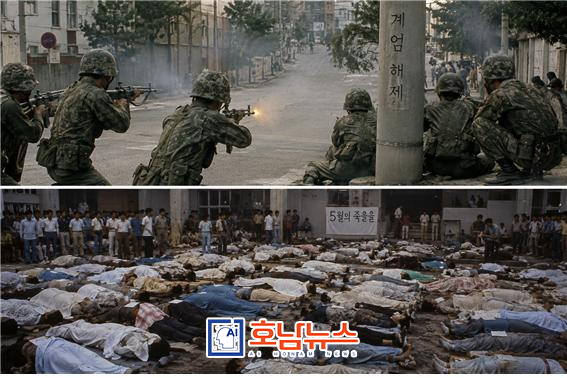 |
【전남·광주=AI호남뉴스】 aihnnews@kakao.com
1980년 5월 23일의 광주는 잠시 ‘해방된 도시’처럼 보였다.
계엄군은 도심 외곽으로 물러났고, 시민들은 스스로 질서를 유지하며 죽은 이들의 이름을 확인하고 부상자를 돌봤다.
그러나 그날의 광주는 결코 평화롭지 않았다.
도심 안에서는 시민들의 애도와 공동체가 이어졌지만, 도시 외곽은 이미 피로 물든 생지옥이었다.
계엄군은 광주를 완전히 고립시키고 있었고, 재진입과 유혈진압 계획을 치밀하게 준비하고 있었다.
총성이 멈춘 것처럼 보였지만, 사람들은 계속 죽어갔다.
새벽 4시 50분, 전남 해남군 우슬재에서는 광주로 향하던 차량 시위대를 향해 31사단 병력이 기관총 사격을 가했다.
이 공격으로 시민 2명이 현장에서 숨졌다.
광주를 돕기 위해 움직이던 시민들을 향한 무차별 사격이었다.
그날 아침 광주 도심은 통곡으로 가득했다.
오전 9시부터 전남도청 뒷마당에서는 희생자들의 신원 확인 작업이 시작됐다.
가족들은 피 묻은 옷과 얼굴을 붙잡고 오열했고, 확인된 시신들은 상무관으로 옮겨졌다.
상무관은 이미 광주의 집단 영안실이 되어가고 있었다.
하지만 같은 시각, 도시 외곽에서는 또 다른 학살이 벌어지고 있었다.
오전 9시 30분, 화순으로 향하던 25인승 미니버스 한 대가 광주 주남마을 인근에서 11공수여단의 집중사격을 받았다.
버스 안에는 학생과 시민들이 타고 있었다.
계엄군은 도주 차량이라는 이유로 집중 사격을 퍼부었고, 최소 11명이 현장에서 목숨을 잃었다.
주남마을 학살은 단순한 오인 사격이 아니었다.
비무장 민간인을 향해 군이 조직적으로 발포한 집단살해였다.
일부 생존자는 총상을 입은 채 논바닥과 도로 아래로 몸을 던져 가까스로 살아남았다.
같은 시각, 3공수여단은 광주교도소 주변에서도 시위대 차량에 총격을 가했다.
이 공격으로 또다시 시민 1명이 숨졌다.
광주 외곽은 사실상 ‘사살 허가구역’처럼 변해가고 있었다.
낮 12시 30분에는 더욱 충격적인 사건이 벌어졌다.
31사단과 11경비대는 민간인 1명을 사살한 뒤 시신을 군부대로 이송했다.
이후 암매장 의혹까지 제기되며, 당시 군의 조직적 은폐 가능성이 오늘날까지도 역사적 진상규명의 과제로 남아 있다.
그러나 시민들은 무너지지 않았다.
오후 3시, 전남도청 앞 분수대 광장에는 시민 5만여 명이 모였다.
광주는 공포 속에서도 민주주의를 포기하지 않았다.
시민들은 ‘제1차 민주수호 범시민 궐기대회’를 열고 계엄군의 학살 만행을 규탄하며 민주주의 수호 의지를 다졌다.
광장에는 분노만 있었던 것이 아니다.
희생자를 추모하는 눈물과 서로를 지키려는 연대의 의지가 함께 있었다.
누군가는 헌혈을 했고, 누군가는 주먹밥을 만들었으며, 누군가는 시신의 이름을 기록했다.
하지만 시민들이 광장을 지키고 있을 때, 군은 다시 광주를 공격할 준비를 하고 있었다.
계엄군은 광주 외곽을 봉쇄한 채 헬기를 동원해 전단지를 살포했다.
전단지에는 ‘무장해제하지 않으면 강경 진압하겠다’는 협박성 내용이 담겼다.
이미 수많은 시민을 학살한 군이 다시 시민들에게 총부리를 겨누고 있었던 것이다.
5월 23일의 광주는 단순한 ‘해방광주’가 아니었다.
그날 광주는 시민 공동체와 국가폭력이 동시에 존재했던 도시였다.
광장에서는 민주주의가 살아 있었고, 도시 외곽에서는 국가폭력이 계속되고 있었다.
대한민국 현대사는 반드시 기억해야 한다.
계엄군이 물러난 뒤에도 광주의 죽음은 끝나지 않았다는 사실을.
그리고 시민들은 그 공포 속에서도 끝까지 서로를 지키며 민주주의를 포기하지 않았다는 사실을.
5월 23일은 광주가 가장 처절하게 울고 있었던 날이자, 동시에 가장 인간다웠던 날이었다.
【AI Honam News Column】
“Gwangju Was Weeping, and the Martial Law Troops Raised Their Guns Again” — May 23, 1980, the Shadow of State Violence Surrounding Liberated Gwangju
The Junnam Village Minibus Massacre, Machine-Gun Fire at Useuljae, and Allegations of Secret Burials… Citizens Mourned While the Military Prepared for Another Bloody Crackdown
【Jeonnam·Gwangju = AI Honam News】 aihnnews@kakao.com
On May 23, 1980, Gwangju appeared, for a brief moment, to be a “liberated city.”
The martial law troops had withdrawn to the outskirts, and citizens maintained order on their own, identifying the dead and caring for the wounded.
But Gwangju that day was far from peaceful.
Inside the city, mourning and solidarity filled the streets, while outside the city limits, a blood-soaked hell was unfolding.
The military had completely isolated Gwangju and was meticulously preparing for a re-entry operation and another violent suppression.
Although the gunfire seemed to have stopped, people were still dying.
At 4:50 a.m., at Useuljae Pass in Haenam, Jeollanam-do, soldiers from the 31st Division opened machine-gun fire on a convoy of demonstrators heading toward Gwangju.
Two civilians were killed on the spot.
It was indiscriminate gunfire directed at citizens attempting to help Gwangju.
That morning, cries of grief filled downtown Gwangju.
Starting at 9:00 a.m., the process of identifying victims’ bodies began in the backyard of the Jeonnam Provincial Office.
Families clung to bloodstained clothing and disfigured faces, wailing in anguish, while identified bodies were transferred to Sangmugwan Hall.
Sangmugwan had already become Gwangju’s mass mortuary.
Yet at the very same time, another massacre was unfolding on the outskirts of the city.
At 9:30 a.m., a 25-seat minibus heading toward Hwasun came under concentrated gunfire from the 11th Airborne Brigade near Junnam Village in Gwangju.
Students and civilians were on board.
Claiming the vehicle was attempting to flee, the troops unleashed heavy gunfire, killing at least eleven people on the scene.
The Junnam Village massacre was not an accidental shooting.
It was an organized massacre carried out by the military against unarmed civilians.
Some survivors, riddled with bullets, survived only by throwing themselves into rice paddies and roadside ditches.
At around the same time, the 3rd Airborne Brigade also opened fire on protest vehicles near Gwangju Prison.
Another civilian was killed.
The outskirts of Gwangju had effectively become a “free-fire zone.”
At 12:30 p.m., an even more shocking incident occurred.
The 31st Division and the 11th Security Unit shot and killed a civilian, then transported the body to a military base.
Later allegations of secret burial emerged, leaving suspicions of systematic concealment by the military as an unresolved historical truth that remains under investigation today.
Yet the citizens did not collapse in fear.
At 3:00 p.m., nearly 50,000 people gathered around the fountain plaza in front of the Jeonnam Provincial Office.
Even amid terror, Gwangju refused to abandon democracy.
Citizens held the “First Pan-Citizen Rally for the Defense of Democracy,” condemning the military’s massacres and declaring their determination to protect democratic values.
The square held not only anger, but also tears of mourning and a powerful spirit of solidarity.
Some donated blood.
Some made rice balls to feed others.
Some carefully recorded the names of the dead.
But while the citizens defended the square, the military was preparing to attack Gwangju once again.
The martial law forces sealed off the outskirts and scattered leaflets from helicopters.
The leaflets threatened that unless weapons were surrendered, a full-scale military crackdown would follow.
The very military that had already massacred countless civilians was once again pointing its guns at the people.
May 23 was not simply a day of “Liberated Gwangju.”
It was a city where civic solidarity and state violence coexisted at the same time.
In the public squares, democracy was alive.
On the outskirts, state violence continued relentlessly.
Modern Korean history must remember this:
Even after the troops withdrew from the city center, the deaths in Gwangju did not end.
And despite overwhelming fear, the citizens never abandoned one another, nor did they give up on democracy.
May 23 was the day Gwangju wept most bitterly — and at the same time, the day it revealed the deepest humanity.
 ai호남뉴스 박충배 편집/칼럼/논설 aihnnewsr@kakao.com